One pattern, one color
This suits most patios and walks, because a single pattern and color costs less up front and is easier to keep looking right. When it's time to reseal, there's one color to match and not much to fuss over.
Plain gray patio or a tired walk and want something nicer? We'll help you pick a pattern and sealer you can live with.
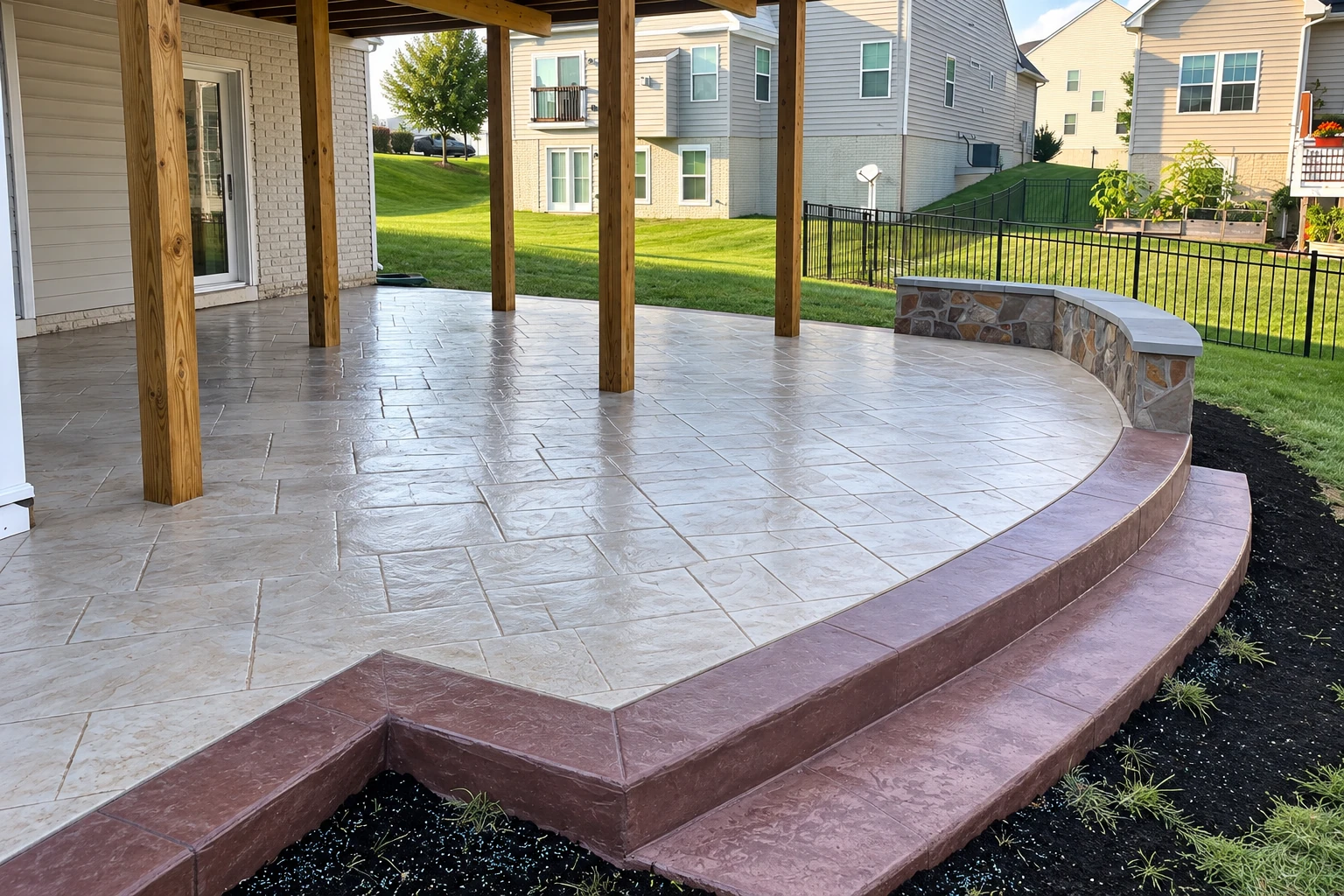
Stamped concrete services in Redmond, WA give you a patio, walk or driveway that's colored and pressed with a pattern while it's still wet, so it can read as stone, brick or slate. Designs run from a single pattern and color up to several colors with borders and custom inlays.
Most calls start with a plain gray slab you're tired of looking at, or an old patio that's cracked, sinking or pooling water and has to come out anyway, and if it's the second kind, I want to know why it failed before we pour something prettier in the same spot. The price moves with the size of the area, how busy a pattern and how many colors you pick, and how much digging and base work the ground needs, while the schedule mostly turns on the weather and, if the job reaches the street, the city permit. I come out, measure and look at the ground, and the estimate gives you your own number. If you're starting from bare yard and want the plain-slab side of it explained, our concrete patio construction page covers that.
I come out for the estimate myself, so the person who measured your yard and walked your drainage is the one on site when the truck shows up. Our own crew does the work, with me running the job from the dig-out to the seal.
We've been at this since 2013, and I learned a good part of it breaking up old slabs to see what went wrong. Old concrete usually tells on itself, so I look at what's under yours and where the water runs before we pour.
We're licensed and insured. Washington requires every construction contractor to register with the state Department of Labor and Industries, and its contractor lookup lets you check anyone before you hire, us included. When you're ready, call (425) 285-8618 or use the form.
We reply within one business day, and the estimate is free, done on site and comes with no obligation. After you send the form, I'll set a time to come out myself, measure the area, check the ground and drainage, and price a simple and a detailed design for you. It helps to have the rough size of the area and the design level you have in mind.
If your stamped walk or driveway reaches the street, the permit comes first. Redmond's Public Works Director issues the permit for any work in the city's right-of-way, the strip along the street the city controls, and that covers work that blocks access or changes city infrastructure like a curb or sidewalk. We find out which city or county office covers your address and what your project calls for before we set a date, then tell you plainly who'll handle the permit and the inspections.
Pour day takes some planning here too. The city's stormwater rules keep concrete truck washout off the ground and out of storm drains, ditches, streets and streams, so we line up an off-site or designated washout spot before the truck arrives, and since the city counts swapping dirt or gravel for concrete as new hard surface, with extra stormwater requirements once a project crosses its size thresholds, we look at that early on gravel-to-patio jobs. Angi's Seattle guide notes that our wet climate calls for extra sealing and drainage planning on decorative concrete, which fits what we see around here, with shady yards, moss and older patios that hold water against the house. We're based in Redmond and do the same work in Kirkland, Sammamish and the other cities around it, and if yours isn't on our pages, just ask.
Stamped concrete in the Seattle area usually costs about $12 to $28 per square foot, according to that same Seattle guide. Where a job lands depends on its size, how complex the design is and local labor rates, and sloped lots may need extra grading or reinforcement, which adds labor and time. Bring the rough size and the design level you want to the estimate and I'll give you your own number.
A topical film-forming sealer, the kind that leaves a thin coat on top, is the most common pick for stamped concrete because it deepens the color. National sealing guidance says penetrating water-repellent sealers soak in and guard against water and stains, but most add no color boost. So it comes down to looks versus protection, and we'll talk through which fits how you use the space.
Reseal it when the surface tells you to, not on a set number of years. The signs are water soaking in instead of beading, stains setting in more easily, or color that looks flat. Hose it down now and then and watch how it sheds water, and you'll catch it before it gets bad.
Yes, if any part of the job falls in the city's right-of-way along the street, since that takes a city permit, as we covered above. We check your address and tell you who'll handle the permit before we set a date.
The usual industry standard for fully cured concrete is 28 days, but the real time depends on where the slab is and the time of year. That's full strength, not the wait before you can walk on it, and we'll tell you when it's ready for feet and when it's ready for a car based on the weather that week. Ask us how the season affects your schedule before you pick a date.