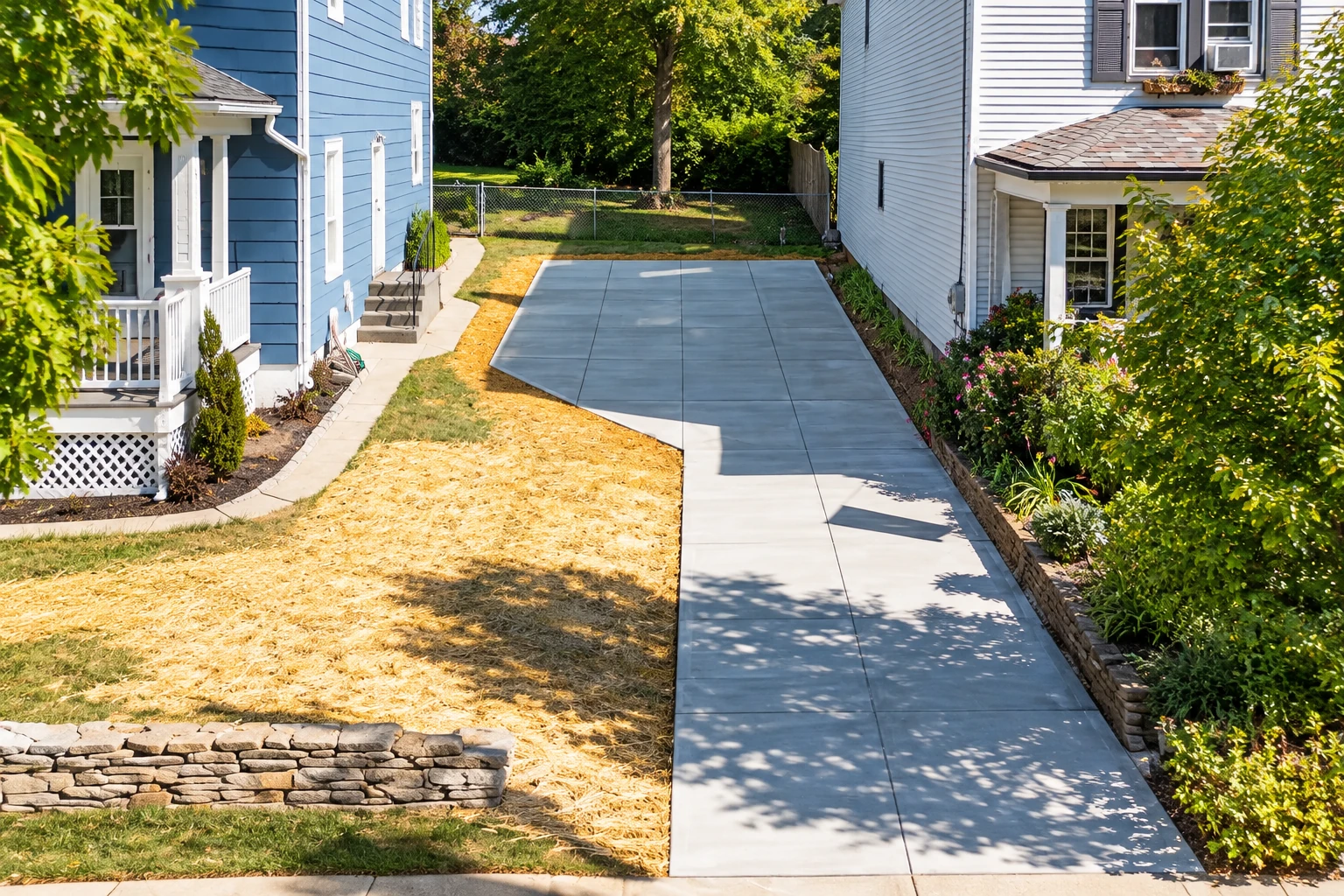
Before we talk about finishes, I want to know what's under the old driveway and where the water goes, because a driveway is only as good as what it sits on. We break out the old concrete and dig down to firm subgrade, the ground the new slab will rest on, then bring in base rock and pack it down instead of raking it level and hoping. The forms get set so the slab falls away from the house and garage, and rebar, the steel bars inside the slab, goes in to help hold it together if it does crack. We pour early in the day rather than in the midday heat that can leave a weak, dusty top, give it a broom finish, a light brushed texture for grip when it's wet, and cut control joints, shallow grooves that give the concrete a straight place to crack, on time instead of days later. Then we cure and protect the slab, and I go over the mix and the curing plan with you before any of it starts, so you know what's going into your driveway.
Driveways, patios and walks are all flatwork, slabs poured flat on the ground, so if you've been putting off a new concrete patio out back, doing it while the crew and the trucks are already here usually makes sense. If you'd like more than plain gray out front, stamped concrete can go on a border, the apron by the street or the whole drive.
Broom finish over a solid base
Most of the driveways we pour get a broom finish, which suits anyone who wants grip in the rain and the most base for their money. If the budget gets tight, I'd cut the finish before the base, because nobody sees the base on day one but everyone sees a sunken corner a few winters later.
Stamped or colored finish
A stamped or colored finish suits a front drive that's part of how the house looks, or a border that ties into a patio. It usually costs more and needs more upkeep than a broom finish, and it only looks good as long as the base under it holds.